Introduction
Before the advent of Christianity in all the tribes including Khongso had beliefs and practices in primal religion. The Khongso were a community that adhered to a number of beliefs and practices that evolved out of their experiences with nature, forest, animals, and community life, and out of their belief in the spirits which was thought as inhabiting in all the spheres of life. These beliefs and practices regulated their way of life, and were a part of their indignation. In times of sickness and hardship, they would resort to magical rites as solution to their problems. They would also worship anything strange and awesome such as something unique be it trees or stones.
When the missionaries spoke about the gospel, many of the tribes were against them as they were apprehensive that their traditional practices and beliefs were to be destroyed by them. But in later times, through the power of the Holy Spirit who worked among the people, some of them believed in Christianity and understood that all the practices and beliefs in animism were wrong. Christianity, no doubt, has been a great transforming factor in the life of the Khongso. However, the worldview presented by Christianity was in sharp contrast with that of the tribal’s, including the Khongso. Thus, they were restricted in adhering to their beliefs and practices deeming them as irrational, superstitious and contrary to the Christian culture.
Primal Religious Beliefs and Practices
The Khongso had an animistic belief in monotheism. Very often, but not always, their worldview transcends the secular-sacred distinction, which is so much a part of modern philosophy. It may be one at the same time sacred and secular. It is pre-occupied with God, spirits and ghosts, but it is patently anthropocentric in most cases. It cements this world and the other world together in a single system.
They live in a world in which supernatural beings and powers are very near. Often, however, there is some recognition of a high god who is far away and also concerned about humankind. The past is very important to the animist whereas the future tends to be of shorter duration and less important. Nature’s spirits are to be found anywhere, in rivers, in trees, in hills, in rocks and other natural phenomena.
Belief in a Supreme God
The Khongsos were religious in their own way. The Khongso believed in the existence of one supreme God, a God of goodness and humanity. Like other Chin tribes Khongso do not worship any heavenly bodies such as the moon, the sun and stars. They worshipped ‘Taqawk’ the invisible supreme Spirit of the land, which they believed was protecting them from disease menace, and physical torture. The Khongsos considered ‘Sithaw’ (Supreme God), as the creator and sustainer of all things. Sithaw is all loving and benevolent and worshipped on every special occasion. However, Khongsos did not have a particular place of worship nor did they worship idols. They worshipped and offered sacrifices on all important occasions. “He” (God) is remembered in every important festivals and on social occasions, such as birth, marriage and death.” In fact, the belief in the supreme God formed the very core of the Khongso’s Religion. Sithaw is perceived as male deity with his abode in the highest heaven. “Prayers are not offered to him as frequently as it is to the malevolent spirits.” When everything else failed, the supreme God is appealed to; he may be approached by anyone without the priest or intermediary at any place.
Belief in the Spirits
The belief in the existence of spirits or spirit occupies an important part of Khongso religion. They believed in the existence of two types of spirits working in the cosmic order, i.e., the Pakhra kasae (benevolent spirits), and Pakhra kahoih (malevolent spirits). The malevolent spirit is responsible for the well-being and prosperity of the people. It is a loving spirit who guards and protects the village from diseases, failure of crops and natural calamities. Thus, the benevolent spirit was worshipped and offered sacrifices by people not because of fear, but out of reverence and love. On the other hand, the malevolent spirit was regarded as dangerous and destructive to all human well-being when provoked. This spirit is believed to live outside the village, on the road side, thick forests, in the fields, rivers, lakes, trees, stones and . All types of suffering such as sicknesses, fever, diseases, death, failure of harvest, sudden appearance of boils, loss of speech, poxes of fever, accidents, madness, natural calamities etc. are attributed to this kind of spirits. In order to wipe off these sufferings, people propitiate the Pakhra kahoih by offering eggs, fowls, pigs, dogs, and other domestic animals. Besides benevolent and malevolent spirits, Khongso believed and gave respect to the ancestors’ spirits. They occasionally invoke them for help and welfare of the family. They honored the ancestors’ spirits by trusting that spirits do come and help at the difficult moments in the life of the living members of the family. Thus, in all their festivals, they offered a portion of their food to them.
Belief in Divination and Omen
The word ‘divination’ is derived from the Latin word ‘deus’ or divus’, meaning “a god or divine, and therefore, and divination deals with that which the divine reveals to us.” In their belief, divination and omen afford an unerring message of the future. By divination they seek to assess whether an undertaking, such as hunting, fishing is worthwhile or whether any war or head-hunting expedition would be successful or not. They seek to determine the will of deities and ascertain the reasons for anybody’s illness.
They used fowls, eggs etc. to read omen. Egg-breaking and the fowl killed and the convulsive struggles of its death agony afford a more reliable indication of the future. Sometimes to ascertain the omen, a chicken’s throat is slit open and its blood is sprinkled around the ground or any object, invoking the name of the spirit. The priest examines the death of the cock and its position. If the right leg comes up above the left leg the omen is good, but if it is vice-versa it is bad. Stumbling on right food while going to fishing, hunting and other business is a good omen.
Belief in Blood Sacrifice
In any kind of sacrifice, there were both social and spiritual significance. They were aimed to ensure the following— (1) For peaceful relationship with God and for his protection, (2) for the good health and welfare of the community, (3) for the fruitfulness in their product or plentiful harvest, (4) for a better life in the next world, and so on. The Qaihmah (priests) are the official organized people who performed all the public sacrifices. For the family sacrifices, the head of the family performed the rite. Sacrifices were done at almost all important events. The cock was the most popular choice of offering. Pig, cow, fowl, dog, egg, mithun, etc., were also offered. Besides animals, drinks and rice frills were also offered to God. A pure and a prayerful life is the basis of true sacrifices. Therefore, one’s total commitment or submission to God (Deity) is the most basic element of a true sacrifice. Numerous sacrifices were made by the tribal. Some of the important sacrifices are the following—(i) sacrifice to spirits who supposed to trouble frequently the village and houses. (ii) Sacrifice to propitiate malevolent spirits in the jungle stream and mountain. (iii) Sacrifice in times of sickness. (iv) Sacrifice to God to cure barrenness in women (v) Sacrifice to God in various stages of life. (vi) Sacrifice to God while going for hunting and killing animals. (viii) Sacrifice to God in various religious festivals. (ix) Sacrifice to spirit for blessing in cattle-rearing, agriculture etc. In each sacrifice, there were elements of invocation, invitation, lastly bidding of farewell.
Belief in Evil’s Forgiveness
According to the Khongso people the good spirit called “Manghaih” would not deal with the sickness and death of a person as they believed that sickness and death were caused by the evil spirit called “Taqawk” or “Chingqaih.” When a person was sick, he/she had to please the evil spirit by offering sacrifices so that he/she might be forgiven. They were so much afraid of evil spirit and were very careful not to make the evil spirit angry. They will not attack men unless provoked. Unfortunately, if unwary man encroaches on their sacred habitation, they get angry and cause all kinds of illness and misfortunes. To recover from illness these evil spirits have to be pleased by sacrifices of appropriate animals. At the sacrifice the animal was killed with the suitable chants, cut the extremities off and placed them on bamboo platform. This was the share of the evil spirit to whom the sacrifice was made. After that the meat was cooked and all of it must be eaten on the spot, usually on the outskirt of the village. This is the way of seeking forgiveness of the evil spirits for their wrong doing before Christianity was introduced among the Khongso. They believed that if the evil spirit is pleased with his or her sacrifice, then he or she will be forgiven for his or her wrong doing and healed from the illness.
Concept of Sin
Lack in the primal religion is the concept of sin. Khongsos regard nothing as specially sin. They saw theft and adultery as evil acts against the well-being of an individual or the community, but they also have a god from whom they sought protection, blessing and forgiveness when they had committed any kind of mistake to spirits and humans. There was no original sin and imputed sin but they believed that sins were any act that offended gods and spirits. Spirits would punish people by bringing misfortune upon them. Yet Khongso had a concept of right and wrong, and a sense of estrangement from the Supreme Being. They did regard certain acts as offence. They accepted the idea that sin is not only an act that harms someone, but also that shows how human can rebel against God. However, they never have seen themselves as sinners who needed a savior. They had a strong belief that observing the traditional way of life was the natural order of things. They perceived the results of various types of behavior and action as both understandable and inevitable. Khongso viewed sin as the result of disturbing the balanced nature.
Understanding on Forgiveness of Sin
The practice of sacrifice was quite common not only among Khongso tribe but also among other tribes of Chin. Especially it was practiced and found in primal or tribal religion. It is true that in the minds of every human being there is a conscience of fear and respect to the god whom one worships and who can protect him/her from troubles and give blessings. In the same way in every community there is their own way of system to solve any problem when something happened among the community. Likewise, Khongso also believed that the god whom they worshipped would forgive their sins, protect them from diseases and give a better living, pardon, riches and fame, so they sacrificed the blood of animal to the spirits when one committed sin against any gods or failed to care and preserve the rituals.
According to the tribal religion of Khongso, there were two kinds forgiveness of sin in the shedding blood of animal. The first practice was done in order to appease the wrath of the evil spirits by pouring the blood of an animal upon the tree or stone where it was believed the spirits were indwelling. By which they thought that the committed sins will be forgiven, and then they would be made not to be affected from different kinds of disease. When they had a guilty feeling in their mind, they had to appease the evil spirits and ancestral spirits, so that they would not be harmed by those spirits. Therefore, the blood sacrifice has become a part of their religious life. And also, they had to offer it at different occasions such as during the time of sowing seed and harvesting. Some sacrifices were made by individuals, some by families and other sacrifices were made by the entire community or village. The second one was done so that when there was a problem between human beings, in order to have reconciliation the blood of animal was shed. They partook together the meal of animal. After that they would forgive each other and resume to have a good relationship. Unless the blood of animal was shed, there would not be forgiveness and reconciliation between the offender and victim but rather enmity and hatred would remain throughout their lives. Then revenge system would continue till the person was killed. Especially in the traditional custom of Khongso, reconciliation was conducted by the chief leader of local people.
Since the Khongsos have a belief in the power of blood it was accepted as an important religious practice in primal religion and used mainly in the sacrificial offerings. Because they were seeking forgiveness of sins through the shedding blood of animal to spirits and offended person, reconciliation and propitiation could be made so that their committed sins would be forgiven judicially. The reason is, through sacrifice, the shedding blood brings peace, forgiveness, blessings and happiness from Sithaw (God). When they offered blood sacrifices to appease spirits and deities, blood represents the solemn presentation of life to God, whereby sacrifices become effective by virtue of the death of the animal or fowl. Therefore, Khongso believed that blood prepares a way to communicate with gods and spirits to receive a pardon and forgiveness when it was invoked accidentally. This practice of blood sacrifice among the Khongso might have contributed to their ability to relate to the gospel and the Christian tenet that there is no redemption without shedding blood (Hebrew 9:22) which was the shadow of Christ’s death on the cross.
Feasts and Ceremony Practices
There are several kinds of feasts and ceremonial practices in the primal religion of Khongso. In every feast and ceremonial practice, there would be cultural dance and drinking local rice-beer. Some of the important feasts and ceremonial practices can be noted as follows.
The Khongso used to celebrate the feasts which would follow certain order, the entire series of feasts together was known as (Poicak). The first feast was called Raengtang which was celebrated at least for two days and in which two mythuns would be killed for feast curry and along with Mu (rice-beer) would be partaken by invited friends. There the young boys and girls of the village would amuse the gathered people with cultural songs and dances. The party would go on for the whole night and would be started afresh next day in the morning with more beer, meat, and food. The second feast was called Raengpui, in which five mythuns would be killed. All the guests and villagers would participate in the feast for 5 days with rice-beer, meats, and food. The next feast was performed when a tiger or wild animal would be shot by any one of the village men. The men would dance around the head of the killed wild animal and enjoy drinking rice-beer.
The marriage ceremony is one of the great ceremonies for the Khongso. The marriage negotiation started with the boy’s father by sending an emissary (Laicaeh) to the girls’ parents with the proposal and a present. When the proposal was accepted, the dowry would be negotiated over rice-beer, in the house of the girl’s father. On the marriage day, certain number of pigs would be killed by both sides. After drinking rice-beer, the bridegroom’s marriage party would sit around rice-beer pot where the marriage ceremony would take place. In some marriages, when the groom and the bride would drink beer together, a fowl would be sacrificed, and then songs would be chanted. The next day the father of the bride, along with friends would go to the groom’s house and they would discuss the bride price again, in full or in part; that day would be spent in feast and drink.
Why this section matters
The document presents a complete internal religious system rather than isolated customs. It links divine order, spirit interaction, illness, sacrifice, social reconciliation, and moral balance into one worldview.
Visual Cultural Context
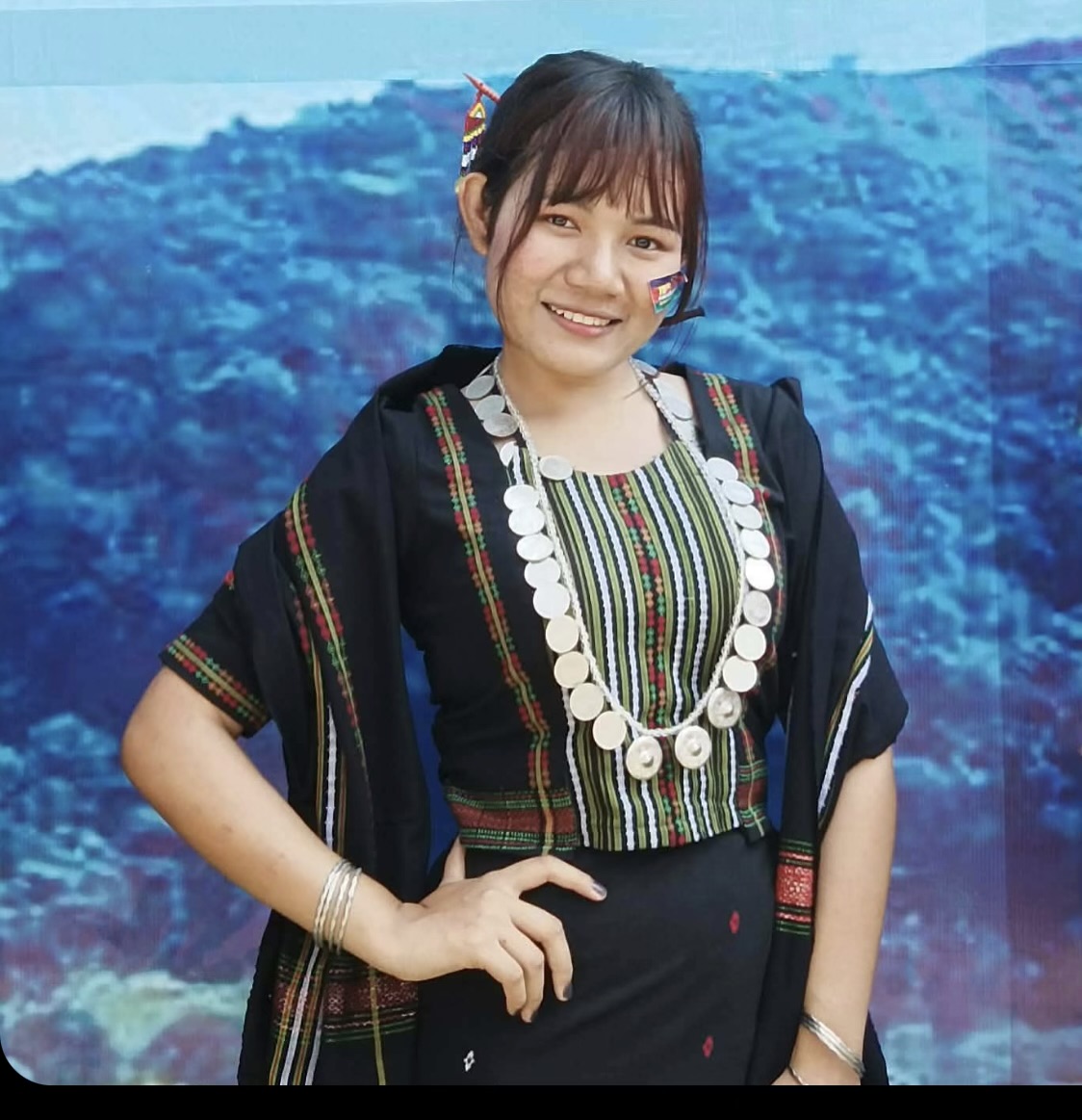
This portrait is a better fit for the religion page than a generic landscape because it preserves a sense of cultural dignity while avoiding the mistake of pretending to visually depict specific historical religious rites.