Socio-Cultural Life
The Khongso society has been an open and free society. There was no sex discrimination, people mixed freely in the society irrespective of their genders. In those times, the clan headship was strong in Khongso society and headman was surrounded by attendants with care and respect. The elders were to be obeyed, young one, and the aged were to be loved, women were to be treated with respect, orphans and widows were to be cared for and needy people were to be helped. The Khongsos mainly cultivated rice, vegetables and cotton in the fields for their food and their clothes, they did not depend on others; they were self-supportive people.
The consumption of rice-beer and opium was common among the Khongsos. Drinking rice-beer, taking opium, and smoking tobacco were closely associated with traditional religious festival and life style. Rice-beer was used in every festival and other religious ceremonies and occasions. Every family used to make rice-beer for their traditional religious festival every year. On any festival occasion they killed pigs, cows, mithuns (sae) and buffaloes. They celebrated festival with drinking rice-beer and dancing cultural dances. Competition among villagers and tribes was prevalent, in form of challenges like who kills more animals and who could drink more rice-beer. Taking opium, smoking tobacco, chewing betel nuts were common among the Khongso. In regard to Chins’ social customs, Biak Cungnung clearly stated that “The people of Chins used such things as a sign of showing hospitality to the visitors. And the house owner would provide such things to visitors who visited his home.”
Historical Conclusion
The Khongso in is seen as one of the Chin tribes that initially settled in the historic post-migration cave called Mintuempaa puk before spreading out to where they are staying today. Like other Chin tribes, the Khongso also maintains a close-knit social structure of family, clan system and dormitory system of organization. They are a patriarchal society where men control almost all aspects of socio-political and religious life with authority and powers. The Khongso, as discussed above, are a distinct people having a distinct way of life.
The following part will attempt to look at some of their particular beliefs and practices that prevailed as the positive elements present in some of them, so as to enhance the consideration of their retrieval in the present Khongso community.
Social and Cultural Life after Christianity
In the , a lot of changes and developments can be seen both positive and negative, throughout her history. The coming of Christianity, along with the gospel brought many changes in their life-style, beliefs, ethical, moral, and religious thinking. At the same time, it also gave a negative impact to the Khongso such as dishonesty, corruption, and individualism. While the new generation has left some traditional customs, they also have adopted Western culture and life-style.
Before the advent of the gospel of Christ, the Khongso customary laws were strictly observed and maintained in the society. When they sacrificed animals to god or evil spirit, the priest would utter some words, and then rice beer would be served. But after the coming of the gospel of Christ, all misunderstanding and unforgiveness were taken over by peace, and harmony in the family as well as in the society. The cultural life of the Khongsos revealed that majority of respondents affirmed that Christianity has totally transformed the cultural life of the people, whereas some of them assumed that Christianity had changed partly but not entirely. The areas changed and unchanged can be seen in the following.
The chanting of some words by priest during the blood sacrifices offering was replaced by Christian prayer to a living God. Singing and dancing with the bottle of rice-beer was replaced by reading and praising song to eternal God with the Holy Bible and Hymnal books. Seasonal festivals and feasts with worldly pleasure were superseded by Christian occasions like Christmas, Good Friday, Easter Sunday and so on. The pre-Christian manner of social gatherings was replaced by Christian meetings; like Bible study, worship services, counseling etc. In pre-Christian era rice-beer or home-made liquor played an important role in the life of the people because it was used on every occasion. Quarrelling with one another and revengeful talking was substituted by praying, forgiveness and teaching one another. Marriage ceremony performed by local priest in the house was replaced by local pastor in the church together with congregations.
Despite the fact that Christianity brought about a near-total transformation in the Khongso life-style, some customary laws have been carried on. The efforts of the missionaries were not directed at changing the basic customs of the Khongso society presumably because they saw nothing much wrong with them. The customs and traditions found meaningless and harmful were replaced by persistent preaching. Thus, tea replaced rice-beer as a popular drink among the Khongso commonly. Animal sacrifices on ceremonial occasions, which were once an integral part of Khongso religious system, are now replaced by fellowship with God. But such tradition as the payment of bride price, making rice beer are still practiced and encouraged in some areas of the Khongso, and also other customs like smoking, chewing betel nuts, taking opium etc. are still prevalent in some areas.
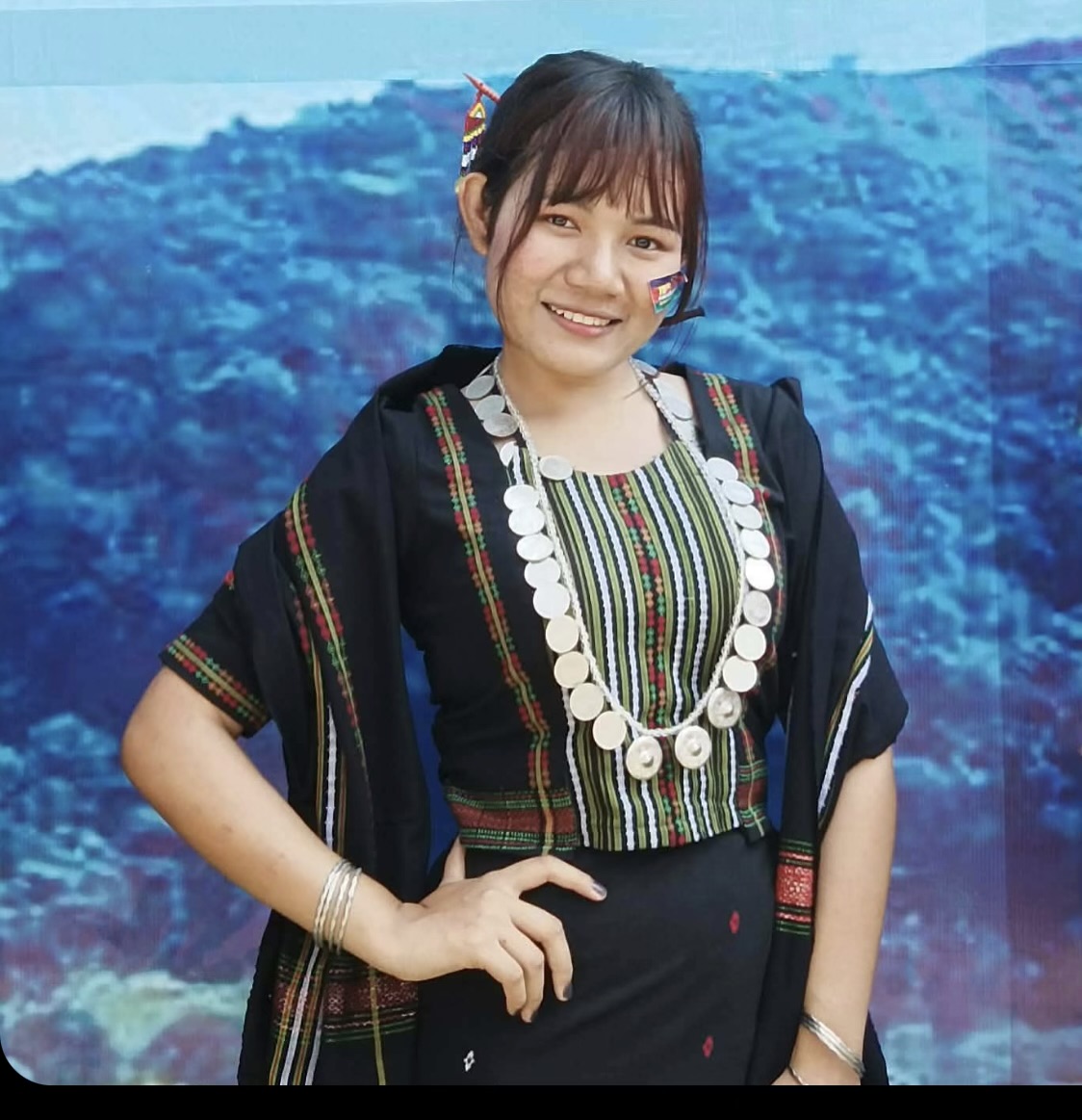
Dress, ornament, and presentation
This portrait works better on the culture page because it gives a clearer view of dress detail, ornament, and how traditional visual identity is presented.