Introduction
The Khongso is one of the government-recognized groups among 135 ethnic groups, and one among 53 sub-groups of Chin State. The Khongsos (the people of Khongso) are one of the hill tribes who are living in and , Southern Chin State of . They have their own traditional cultures, societies, literature and languages. But to trace and write about ethnography of the Khongso community as a whole is not an easy task because unfortunately, they have very few written documents and records about it. Whatsoever, written here will be the outcome of the interviews with elders who are still alive and who know the historical background of Khongso tribe and their activities before and after coming of Christianity.
The pioneer missionary Rev. That Dun introduced Christianity among the Khongso in the middle of twentieth century, that is, in 1944. Within a half century, Christianity gained a significant growth in most of the populated areas of the land. The rapid growth and spread of Christianity was primarily the result of the work of the Holy Spirit through the revival meetings; at the same time, it was the result of the work of the dedicated missionaries. A brief study of historical background, religious beliefs, and practices before and after Christianity and understanding of Khongso tribals on forgiveness of sin will be introduced for a better understanding of the subject of this project in this chapter.
Origin and Chinlung Tradition
The origin of the Khongso can be traced back through their traditional myths and the records of the historians though it is hard to identify the exact site of their origin. According to Khongso and Mizo-Kuki-Chin traditions, their ancient home was called “Chinlung or Singlung.” The meaning of Chinlung is “a covering stone or rock.” It has been said in the history from oral tradition that of Chins including Khongso emerged into this world from the bowels of the earth or cave called “Chinlung.” Therefore, the people of Khongso believed that they originated from that great cave hole. According to L. H. Songate, “all the Mizo-Kuki-Chin’s ancestral place is Chinlung or Singlung, and the location of “Chinlung” was the present Tailing or Singlung in South-West China. Lian H. Sakhong also described in his dissertation that the tradition that “Chinlung” is the original home of the Chin has been kept by all the tribes of the Chin in various ways.”
Even Khongso forefathers also claimed and suggested that their ancestral home is somewhere in central Asia or . It might be true that the Khongso had to leave out of their homes because of the cruelty of the Chinese ruler or the famine there. However, the reason why these people left the Chinlung has never been clearly told and explained. Regarding the leaving from that place, F. K. Lehman stated that “Some of the settlers in Chinlung have conjectured their subsequent nomadic life to have come out due to their inability to repel their enemies while they were in Chinlung or Singlung.”
Land, Location, and People
Khongso land is a hilly place and located in the Southern part of the Chin Hills, Western part of Myanmar. It has not yet become a recognized land with distinctive geographical features of its own, but the land has been inhabited since forefathers’ age. has been the main resources for the economy of the people since the area is rich in flora, fauna and paddy field cultivation. Hunting, gathering of fruits and roots, and fishing are their main pursuits for living. In Khongso land there are three main climates: summer, winter, and rainy seasons. The land is located in temperate zone. The temperature is generally between 5 C and 20 C. The rainy season starts at the end of May and ends in October. There are 65 villages in the land of Khongso. According to an account of Mr. Thang Long (of Khongso tribal literature committee), in 2012 the total population of the land was 24307.
The Land is located between which is the end part of , and Mi River and Ru River that runs from the Eastern part of . Khongso land is situated between 21 42' and 42 22' of North latitude and between 92 37' and 94 47' of East longitude. It is bounded on the East by Matupi land, the West by Khumi and Anu land, the North by Mara and Mizoram State of India and the South by Dai and Myo-khami land. The length of the Land of Khongso is about 70 miles from the East to the West and 40 miles from North to South. In the land, there are major tribes namely: Khongso, Anu, Likhoeng, Lemi, Mara, Rakhine, Myo-khami, Khumi, Rengca, and Matu. The Khongso land is situated between 800 m and 3000 m above the sea level. The highest mountain in the land is (4269 m height) located in the West of the land.
Khongso is one of the Chin tribes of . It is one of the great Indo-Mongolian tribes with Tibeto-Burmese language group. Firstly, they migrated from and then to Western part of to their present habitat. The Khongso tribe is divided into two clans or sub-tribes. They are Khenlak and Sangta. There are 23 families included in Khongso tribe: namely Kungca, Pakawt, Nisae (Lung Khra), Kapui, Lenvai, Tamlai, Boiqing, Khongpui, Thung Noeng, Ang Ting, Sentak, Sangta, Laikawt, Humtae, Thuipraek, Satoek, Humnan, Kaca, Pa-ngan, Lungtak, Lamluek, Rahnoem, and Aima. Khongso tribe has two literatures, which is Khongso and Asang (Khongso) representing Khongso people, that was approved and signed between two boards in Paletwa Town on March 24, 2014. In accordance with the agreement, any of which could be freely applied among the community in writing, depending on their choice, their interest, and their comprehension. The Khongso people have a highly patriotic spirit. They are cheerful, honest, unselfish, democratic and stubbornly independent. They also have an unsophisticated, realistic outlook on life and revenge. The people are basically hard working and healthy people with strong religious indebtedness. Their ethnic tribe’s symbol is Tangdaeng (rocket tail Drango). Along with it lings Langla pawk (Bulbophyllum refractor, one of orchid species) is their royal flower.
| Villages reported | 65 villages |
|---|---|
| Population reported | 24,307 in 2012 |
| Dimensions reported | About 70 miles east to west and 40 miles north to south |
| Elevation reported | Between 800 m and 3000 m above sea level |
| Highest mountain | Kima Mt., reported as 4269 m |
Politics, Migration, and Settlement
Khongso land was a separate land with its own boundaries for centuries. No Burmese king had occupied and ruled the land. History says that the successive Burmese dynasties until 1885 had never included the . It was only in 1928 that the British included Chin land as a part of the . Even though the Khongso land was a separate territory, there were no kings for tribal Chiefs rather heads of various clans were the local rulers and the protectors of their respective clans. Each man had to guard his family with swords, shields and lances because of feuds, which came to cease only after the British annexation of Khongso land. The people were administered by the headmen of villages.
After was wholly occupied on 1st January 1886, the British forces were sent through the Southern Chin State in 1888–1929. The British rule on the land lasted till 1929. The Khongso people were famously known and appreciated by the British forces because of their bravery, courage, and determinative nature in their resistance to the forces. At present, the people of the land live with peace and freedom from any colonial government.
The Khongsos migrated from Chinlung through Himalayas, and reached Chindwin Valley around 9th century A.D. It is located in Eastern part of . Basing on the traditional and anthropological studies, G. A. Grierson said that these groups are the people belonging to Mongoloids of Kuki-Chin group of Tibeto-Burma family. According to the record of Lian H. Sakhong, “the Chin people were the first who settled in the .” Then, there is also persistent reference in the legends of almost all the Chin tribes (Asho, Matu, Mindat, Kanpalet, Paletwa, Hakha, Falam, Tedim) to a former home in the Chindwin Valley. According to tradition prevailing among the Khongso, they have migrated from various places around present Hakha, and Rezua, where they settled for some time and then came to present Khongso land which they have been occupying at least for four hundred years now. But beyond that even oral traditions of the Khongso do not indicate any clue to the place of their origin.
The Khongso group came to their present habitat with other groups from , that is, to and Chindwin Valley of Myanmar. According to Khongso forefathers and the story of oral tradition, the first settlement was in the , but unfortunately when it was destroyed by the flood, they crossed and moved to a big cave called Mintuempaa puk (Lailun in Chin). After staying there for some years, they moved down to Western land of Chin State; Hakha and Matupi, and at last settled down around Hmuet and Phoisang Hill Ranges around 14th century. These hill ranges stretch over western part of Matupi Township between Pamai and Chakhine villages, 40 miles away from Matupi Town. According to the record of British captain Burn, Phoisang Hill was called “Lepring Hill.”
The story says that this migration was forced down on them both by the strong people of and a great famine. Regarding the time and date of their departure from it is not recorded, but it would probably be during the 13th century. But according to Lian H. Sakhong, “Although we do not know exactly when and why, the date can be set approximately to the first years of 13th century or the beginning of 14th century.” After settling down for many years in Hmuet and , some of the Khongso migrated to and Mi River. At present they are staying between Phoisang Hill Range and Kima Mountain. Most of Khongso people live in these villages: Lui Vang, Bawi Ring (A), Bawi Ring (B), Suipinkung, Vadaengkung, Pahangkung, Zongkung, Saekung, Dawkung, Lakangkung, Toengkung, Paakung, Suisip, Laekkung Tuiqongkung, Lamoi, and Cingcang. And some of Khongsos live in these villages with other tribes: Dai Hnan, Khua Hung, Pai (Auk Cangki), Tawkkung, Boilee, Ka Naung, Sami town, Ayangkung, and Halawkkung. And nowadays some of Khongso people migrate and live in Yangon, Myanmar and even foreign countries like India, Malaysia, Canada, USA, Australia, and Norway.
Socio-Cultural Life and Historical Conclusion
The Khongso society has been an open and free society. There was no sex discrimination, people mixed freely in the society irrespective of their genders. In those times, the clan headship was strong in Khongso society and headman was surrounded by attendants with care and respect. The elders were to be obeyed, young one, and the aged were to be loved, women were to be treated with respect, orphans and widows were to be cared for and needy people were to be helped. The Khongsos mainly cultivated rice, vegetables and cotton in the fields for their food and their clothes, they did not depend on others; they were self-supportive people.
The consumption of rice-beer and opium was common among the Khongsos. Drinking rice-beer, taking opium, and smoking tobacco were closely associated with traditional religious festival and life style. Rice-beer was used in every festival and other religious ceremonies and occasions. Every family used to make rice-beer for their traditional religious festival every year. On any festival occasion they killed pigs, cows, mithuns (sae) and buffaloes. They celebrated festival with drinking rice-beer and dancing cultural dances. Competition among villagers and tribes was prevalent, in form of challenges like who kills more animals and who could drink more rice-beer. Taking opium, smoking tobacco, chewing betel nuts were common among the Khongso. In regard to Chins’ social customs, Biak Cungnung clearly stated that “The people of Chins used such things as a sign of showing hospitality to the visitors. And the house owner would provide such things to visitors who visited his home.”
The Khongso in is seen as one of the Chin tribes that initially settled in the historic post-migration cave called Mintuempaa puk before spreading out to where they are staying today. Like other Chin tribes, the Khongso also maintains a close-knit social structure of family, clan system and dormitory system of organization. They are a patriarchal society where men control almost all aspects of socio-political and religious life with authority and powers. The Khongso, as discussed above, are a distinct people having a distinct way of life.
The following part will attempt to look at some of their particular beliefs and practices that prevailed as the positive elements present in some of them, so as to enhance the consideration of their retrieval in the present Khongso community.
Community continuity
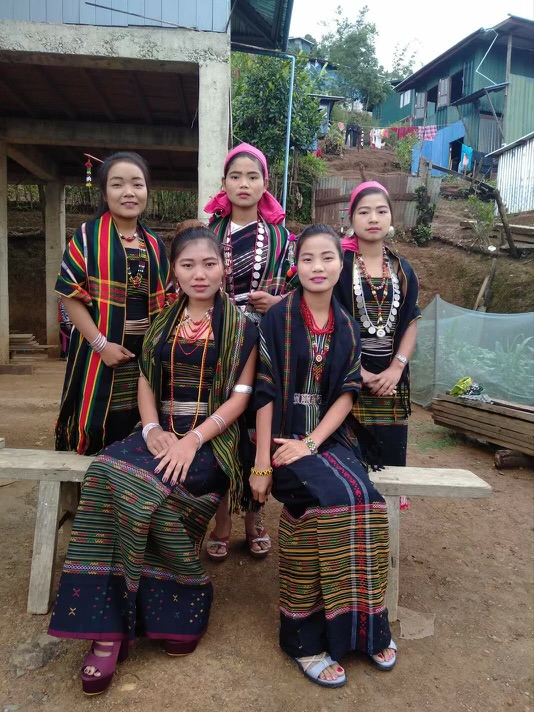
This community image supports the history page by linking the historical record to living people rather than leaving the page entirely text-based.